Whoever designed this so-called "bench" outside the building should be strapped to said "bench" and forced to sit upon it for twelve hours. That, trust me, would be sufficient punishment for this egregious crime against the human body.
Showing posts with label Entries with pictures. Show all posts
Thursday, November 12, 2009
Architectural Crimes, an Ongoing Series
Spent several hours the other day at the MGM Tower in Century City. And I must say this:

Whoever designed this so-called "bench" outside the building should be strapped to said "bench" and forced to sit upon it for twelve hours. That, trust me, would be sufficient punishment for this egregious crime against the human body.
Saturday, April 04, 2009
Another Day at the Office
Saturday, March 28, 2009
Wallowing in Nostalgia
My junior year of high school, some friends of mine were in a one-act called "Did You Ever Go to P.S. 43?" by Michael Schulman. In it, a woman sits on a park bench, minding her own business, when a man comes up and asks her whether she went to the school listed in the title. We soon learn that he was once a star athlete at that school who had one fantastic game, one perfect night, early on in his life--and that nothing was ever so good again. So he roams the city, asking random strangers whether maybe they were there, whether they can validate his life by remembering that one perfect night with him.
A group of people I went to high school with has slowly gathered on Facebook, over the past couple of months, and I have found myself nearly obsessed with the group. I started scanning old photos, even old programs, and of course started to actively seek out people I hadn't seen in something like a quarter of a century. A formal group got created on Facebook just for the performers at that school in certain years, which had the effect of creating an ongoing high-school reunion where only the people you liked showed up. (As opposed to the one actual reunion I attended, my tenth, where I ended up disappointed because most of the performers weren't there.)
No question, it's been great reconnecting with some people I hadn't seen in all that time; there are even a couple folks I really hadn't known that well back then, but who are now becoming actual friends, not just of the Facebook kind. The old artificial distinctions of age drop away (who cares now whether someone was a year ahead or behind?), and we can all just be people with a certain specific connection, sharing the old stories--indulging ourselves, as much as we want, in a bit of harmless nostalgia.
And as I wallow, my memory of those days has become golden. All the pictures in my head look something like this...

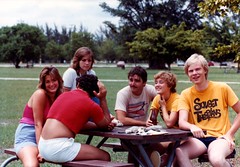
That's me looking goofy on the right, but smiling and cheerful, with old friends, some of whom are now members of that Facebook group. (And one of whom, Rudy Prieto, in the red shirt with his back to the camera, passed away years ago, alas.) But why shouldn't I be smiling? By my senior year, I was completely in command. I had leads in both the major shows, completely knocking it out of the park as Fagin in Oliver! The school created a closed-circuit TV system that year, so my best friend David Hernandez and I did the morning announcements as a pair of oddball TV anchors, playing as many pranks as we could possibly dream up--and since I was on TV every morning, absolutely everyone in school knew me, and said hi, and kinda sucked up in the way that only happens when you're on TV, even closed-circuit TV that never leaves that one building. Every morning I would get to school half an hour early, just so I could hang out near the Drama classroom with my friends before classes started. I was in Advanced Placement classes, got good grades, and didn't have to take math. What more could a fella want?
But here's the thing. A few days ago I wanted to look up some specific information that required pulling out the journals I started keeping my first year of high school. And there, in horrifically bad writing, was the truth of how I felt back then. Which is to say, miserable.
Every stupid little insult. Every moment at a party when I felt snubbed. Every unrequited crush. Every moment that didn't meet some unattainable standard of perfection, I dwelled on all of it, and refused to enjoy all the moments that were, in fact, pretty damn great. It was as if I were that guy in Schulman's play, who has in fact found people who remember his big game--but who has now discovered that even when he was having his great moment, he was completely unable to enjoy a second of it. Best moment of his life and all he did at the time was gripe.
(By the way--I am not that guy. Plenty of great moments since high school, thank you very much. Most recently, watching my name scroll across a movie screen for the first time, in a crowded theater, that was just plain fantastic. Plenty more of those moments to come, too--I feel like I'm only just beginning to peak, right now. So there.)
(And, of course, all of the above could also be summed up thusly: I was a teenager, and that's what we do. C'est la vie.)
Still, I can't escape the conclusion that the only reason I was miserable was because I wanted to be. And that if I'd been able to simply make the other decision, the Buddhist decision to simply be where I was and experience life as it was rather than as I desired it to be, I'd have had a hell of a lot more fun back then.
Of course it's all a vicious cycle: if I'd been able to enjoy myself a little more, doubtless there wouldn't have been quite so many stupid little insults, awkward moments at parties, or unrequited crushes. When I wrote Thereby, I discovered the one theme that has come to dominate all my work: that our lives are like stories, and we're the tellers of those stories. Whether they go well or badly is entirely up to us.
Now I learn that lesson again, through my own awful high-school journal entries. A perfectly lovely time made miserable by nothing more than my decision to be miserable. A story that could have gone so much better, if only I had allowed myself to tell it that way.
A group of people I went to high school with has slowly gathered on Facebook, over the past couple of months, and I have found myself nearly obsessed with the group. I started scanning old photos, even old programs, and of course started to actively seek out people I hadn't seen in something like a quarter of a century. A formal group got created on Facebook just for the performers at that school in certain years, which had the effect of creating an ongoing high-school reunion where only the people you liked showed up. (As opposed to the one actual reunion I attended, my tenth, where I ended up disappointed because most of the performers weren't there.)
No question, it's been great reconnecting with some people I hadn't seen in all that time; there are even a couple folks I really hadn't known that well back then, but who are now becoming actual friends, not just of the Facebook kind. The old artificial distinctions of age drop away (who cares now whether someone was a year ahead or behind?), and we can all just be people with a certain specific connection, sharing the old stories--indulging ourselves, as much as we want, in a bit of harmless nostalgia.
And as I wallow, my memory of those days has become golden. All the pictures in my head look something like this...
That's me looking goofy on the right, but smiling and cheerful, with old friends, some of whom are now members of that Facebook group. (And one of whom, Rudy Prieto, in the red shirt with his back to the camera, passed away years ago, alas.) But why shouldn't I be smiling? By my senior year, I was completely in command. I had leads in both the major shows, completely knocking it out of the park as Fagin in Oliver! The school created a closed-circuit TV system that year, so my best friend David Hernandez and I did the morning announcements as a pair of oddball TV anchors, playing as many pranks as we could possibly dream up--and since I was on TV every morning, absolutely everyone in school knew me, and said hi, and kinda sucked up in the way that only happens when you're on TV, even closed-circuit TV that never leaves that one building. Every morning I would get to school half an hour early, just so I could hang out near the Drama classroom with my friends before classes started. I was in Advanced Placement classes, got good grades, and didn't have to take math. What more could a fella want?
But here's the thing. A few days ago I wanted to look up some specific information that required pulling out the journals I started keeping my first year of high school. And there, in horrifically bad writing, was the truth of how I felt back then. Which is to say, miserable.
Every stupid little insult. Every moment at a party when I felt snubbed. Every unrequited crush. Every moment that didn't meet some unattainable standard of perfection, I dwelled on all of it, and refused to enjoy all the moments that were, in fact, pretty damn great. It was as if I were that guy in Schulman's play, who has in fact found people who remember his big game--but who has now discovered that even when he was having his great moment, he was completely unable to enjoy a second of it. Best moment of his life and all he did at the time was gripe.
(By the way--I am not that guy. Plenty of great moments since high school, thank you very much. Most recently, watching my name scroll across a movie screen for the first time, in a crowded theater, that was just plain fantastic. Plenty more of those moments to come, too--I feel like I'm only just beginning to peak, right now. So there.)
(And, of course, all of the above could also be summed up thusly: I was a teenager, and that's what we do. C'est la vie.)
Still, I can't escape the conclusion that the only reason I was miserable was because I wanted to be. And that if I'd been able to simply make the other decision, the Buddhist decision to simply be where I was and experience life as it was rather than as I desired it to be, I'd have had a hell of a lot more fun back then.
Of course it's all a vicious cycle: if I'd been able to enjoy myself a little more, doubtless there wouldn't have been quite so many stupid little insults, awkward moments at parties, or unrequited crushes. When I wrote Thereby, I discovered the one theme that has come to dominate all my work: that our lives are like stories, and we're the tellers of those stories. Whether they go well or badly is entirely up to us.
Now I learn that lesson again, through my own awful high-school journal entries. A perfectly lovely time made miserable by nothing more than my decision to be miserable. A story that could have gone so much better, if only I had allowed myself to tell it that way.
Monday, February 16, 2009
On Slowness
In 1987, John Cage wrote a piece for organ called "As Slow as Possible." The idea is that the performer should take the title literally--that while the relationships between the notes should never change, only the performer's notion of what "slow" means would determine the final length of the piece. (In other words, a whole note is still a whole note, an eighth note still an eighth note--but how long they last is up to the artist.) Performances generally run from 20 to 70 minutes--but on February 5th, Diane Luchese gave a performance at Towson University that ran for just under 15 hours.
I love what the Baltimore Sun's music critic, Tim Johnson, had to say about this particular form of musical insanity. He "stopped by" in the tenth hour of the performance, noting that there were only a dozen audience members when he arrived, and four by the time he left. But he went on to say this:
I've written about "deep time" before, and it seems to me this Cage piece is the musical equivalent of it. Something that shifts your perspective right round, taking you out of the go-go now and drops you into something larger and stranger and richer.
Slowness is anathema to we modern-folk, but it has much to be said for it. Just today I had to drive during a pretty horrible rainstorm, and I fast became a fan of slowness. (It had something to do with not dying.) But I find the virtues of slowness in more and more places, lately: I have become a slow reader, so that it takes months to get through a book sometimes, but your experience of a book is definitely different when you linger, and let the words work on you; and exercise is most definitely a more valuable experience when done slowly. (There's a chain of fitness clubs in L.A. called SuperSlow that operates on exactly this principle. Try it, try any exercise you do regularly, and do it at half-speed. You'll notice the difference in a big way.)
But Ms. Luchese's fifteen-hour marathon of "As Slow as Possible" is nothing compared to the one going on, right now, at the St. Burchardi church in Halberstadt, Germany.
The total length of this performance of Mr. Cage's composition? Six hundred thirty-nine years.
There is a very entertaining reason for why this specific span of time was chosen, and you can read about it on the page linked above. But suffice it to say that at the church, right this very moment, a single chord is being played, on and on, and it won't change at all until July 5, 2010. And it seems to me that, aside from this endeavor being sheerest insanity, it is also madly inspiring: it takes a certain resolute optimism to believe that such a thing is even possible. It makes me want to save the world, just so that organ can continue playing for the next 600-plus years.
It occurred to me, when I first heard this story, that it would make for a fascinating documentary. So I was a little disappointed to discover recently that someone named Scott Smith has already made one. But as I was looking at his website, I clicked for a page and got the following result, which so delighted me that, without further comment, I now present it for you. Go ahead, click on it, it's worth it, I promise.
I love what the Baltimore Sun's music critic, Tim Johnson, had to say about this particular form of musical insanity. He "stopped by" in the tenth hour of the performance, noting that there were only a dozen audience members when he arrived, and four by the time he left. But he went on to say this:
Sustained low notes on the organ's pedals created a visceral, fundamental rumble that suggested the drone of some cosmic machinery. Dissonant chords appeared and disappeared unpredictably above that pulsating foundation--chance encounters with sonority. Almost each change in notes or tone colors seemed positively cataclysmic in this glacial context.
I've written about "deep time" before, and it seems to me this Cage piece is the musical equivalent of it. Something that shifts your perspective right round, taking you out of the go-go now and drops you into something larger and stranger and richer.
Slowness is anathema to we modern-folk, but it has much to be said for it. Just today I had to drive during a pretty horrible rainstorm, and I fast became a fan of slowness. (It had something to do with not dying.) But I find the virtues of slowness in more and more places, lately: I have become a slow reader, so that it takes months to get through a book sometimes, but your experience of a book is definitely different when you linger, and let the words work on you; and exercise is most definitely a more valuable experience when done slowly. (There's a chain of fitness clubs in L.A. called SuperSlow that operates on exactly this principle. Try it, try any exercise you do regularly, and do it at half-speed. You'll notice the difference in a big way.)
But Ms. Luchese's fifteen-hour marathon of "As Slow as Possible" is nothing compared to the one going on, right now, at the St. Burchardi church in Halberstadt, Germany.
The total length of this performance of Mr. Cage's composition? Six hundred thirty-nine years.
There is a very entertaining reason for why this specific span of time was chosen, and you can read about it on the page linked above. But suffice it to say that at the church, right this very moment, a single chord is being played, on and on, and it won't change at all until July 5, 2010. And it seems to me that, aside from this endeavor being sheerest insanity, it is also madly inspiring: it takes a certain resolute optimism to believe that such a thing is even possible. It makes me want to save the world, just so that organ can continue playing for the next 600-plus years.
It occurred to me, when I first heard this story, that it would make for a fascinating documentary. So I was a little disappointed to discover recently that someone named Scott Smith has already made one. But as I was looking at his website, I clicked for a page and got the following result, which so delighted me that, without further comment, I now present it for you. Go ahead, click on it, it's worth it, I promise.
Labels:
Deep time,
Entries with pictures,
John Cage,
Slowness
Saturday, January 31, 2009
Just Because
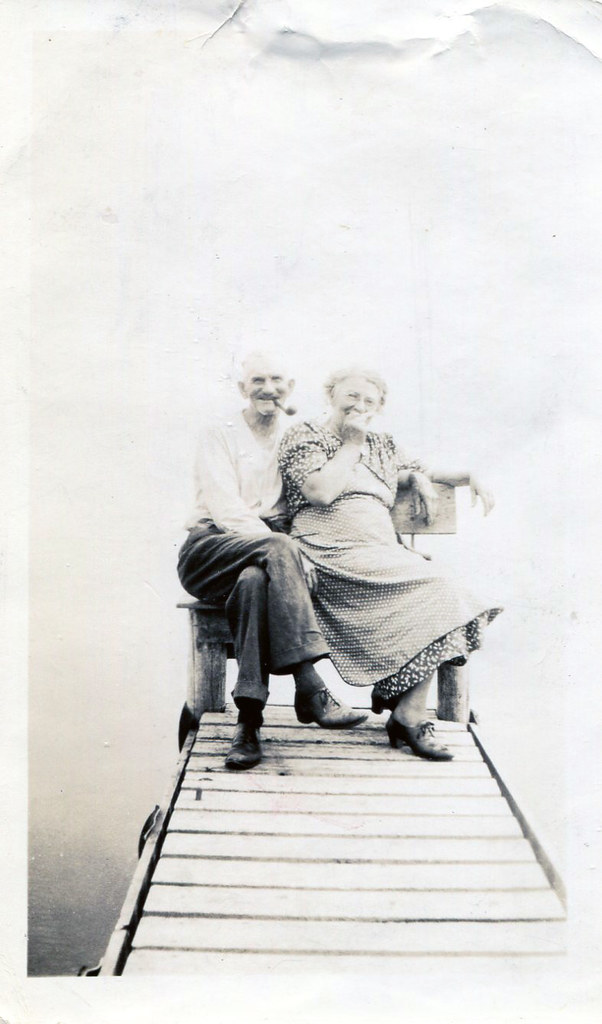
It is in fact a picture of specific people: Burt and Stella Burbank, my maternal great-grandparents, sitting at the end of a jetty in Ohio. But it also happens to be one of the best photographs I think I've ever seen, whether I'm related to these folks or not.
Plus I just got the newest version of iPhoto, and I've been tagging things, and I can't resist putting this particular photograph out there for the world.
Tuesday, August 05, 2008
For Gil
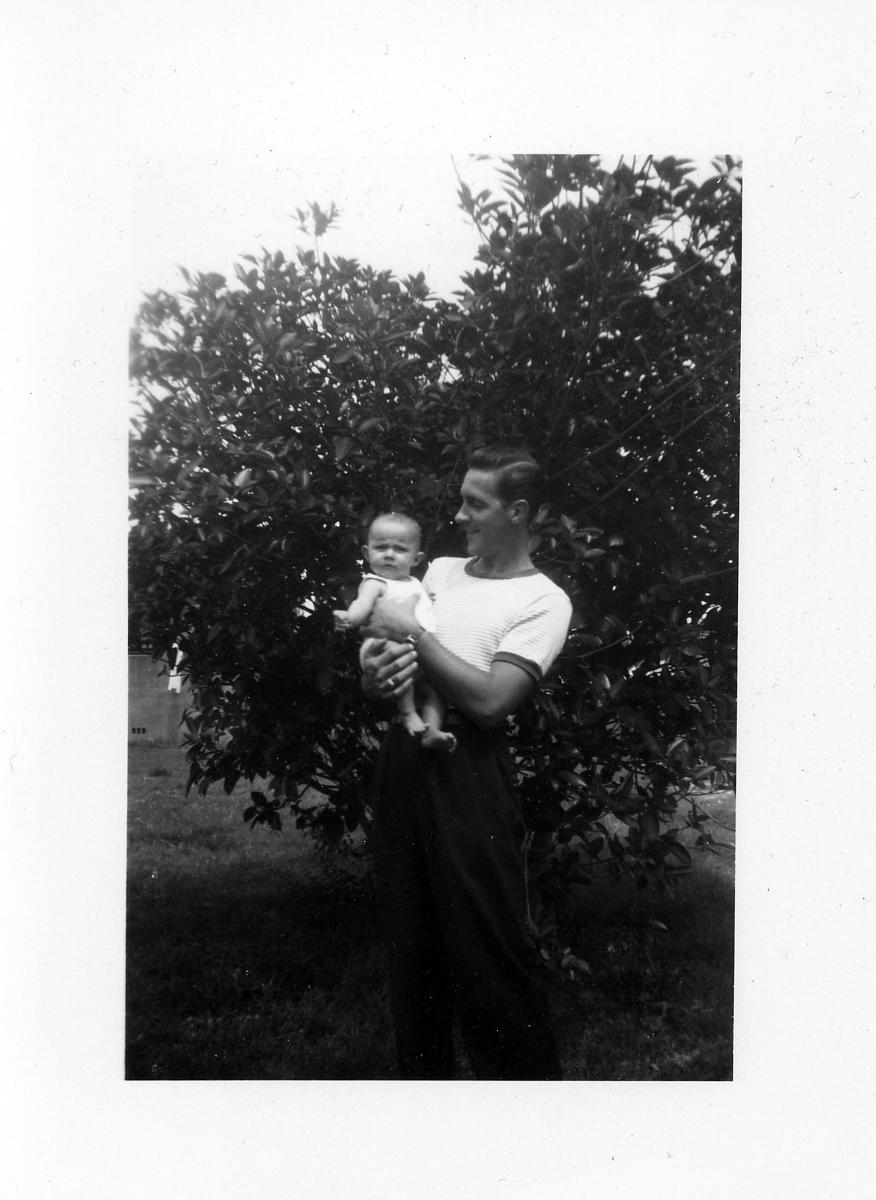
A photo of my grandfather and my mother, taken a couple years ago. Posted tonight because my grandfather died today, and because eventually we are all transformed to memory. And because I am now fresh out of grandparents.
Labels:
Entries with pictures,
Grandparents,
Passages
Saturday, November 24, 2007
The Guns of Dealey Plaza
This is true: at the entrance to the Sixth Floor Museum, which is what has become of the Texas Book Depository in the years since President Kennedy was assassinated, there is a sign reminding people that they shouldn't bring guns inside.
And for some reason, I was the only person in the immediate vicinity who found that ironic.
My father and step-mother recently moved to Dallas for work, and I flew out for Thanksgiving. Shortly after reaching the airport I saw one of those red crawl-displays displaying the date, November 22, and realized that I was making my first visit to Dallas on the anniversary of the Kennedy assassination in that same city. So I had JFK on my mind practically from the first moment, and it's not such a surprise, really, that the one thing we all decided to do the Friday after Thanksgiving, before we all flew off to our different places again, was to visit Dealey Plaza.
Since the anniversary itself happened to fall on Thanksgiving, most people visited the next day, as I did, and there was a circus going on all across Dealey Plaza. (Here's a photo of the crowd on the grassy knoll.) There were guys selling things near the entrance, the same sorts of guys you'll see hawking t-shirts outside concerts or selling maps of the stars' homes in Beverly Hills. I leaned over to my sister and said "Hey, one of the great tragedies of American history happened here! Let's exploit it!" My step-mother politely declined to spend five bucks on one of their printed maps of the area.
We paid $13.50 per adult, which seemed a little steep, but it included an audio thingie that you hung around your neck. There really wasn't anything on the tape that added to the materials already on display, and the crowds were so large that the tape was moving way faster than I was; about halfway through I turned it off for good and explored at my own pace.
And yes, right at the entrance, where the young guy took our tickets, there was a posted sign reminding people not to bring guns inside. I asked if anyone found that ironic, and the young ticket-taker said "Well, this is Texas," and my dad pointed out that Texas is a concealed-carry state. All of which I knew perfectly well: it was the fact that in this place dedicated to perhaps the most notorious shooting of all time, people needed to be reminded that bringing a gun was perhaps in bad taste.
Apparently I hadn't sufficiently learned from the map-sellers outside that where money is to be made, bad taste really doesn't enter into the equation.
The exhibition itself strives for good taste by broadening its reach beyond the assassination: brief portraits of the Sixties, of Kennedy himself, and of his administration (prompting Dad to recollect when he was serving on an aircraft carrier during the Cuban Missile Crisis, right at the front line at what turned out to be the moment of greatest tension, almost entirely unaware of what was actually going on). But of course the museum doesn't have much in the way of artifacts to go along with these displays: the Kennedy Library in Boston, quite naturally, has all of that, together with the National Archives.
The plain truth, then, is that this is a museum about one event: an assassination. Here too the curators strive to be as tasteful as possible, given what the museum is: blown-up still frames from the Zapruder film don't show quite the worst moment, though they come close. There is a photo of President Kennedy's dark suit jacket showing the bullet hole, but not of his white shirt, which shows the blood much more obviously. And of course there are no autopsy photos or diagrams, for which many thanks. (Yes, you can find all of that on the internet, if you must.)
And there is plenty on the investigation itself, including the FBI's scale mock-up of Dealey Plaza. But what matters most, of course, is the window itself, from where Oswald fired. A giant glass box surrounds the area now, and empty book boxes seek to recreate the situation: boxes stacked high in order to conceal someone crouching behind, peering out through a rifle's telescopic sight, waiting for the right moment.
And I have to say, all conspiracy theories aside: if you were going to do such a thing, that was a perfect place for it. Coming along Houston Street, the motorcade made a sharp left onto Elm Street, which immediately curves back almost in the same direction they just came from before proceeding on toward the highways. This means the motorcade would have had to slow down to make the turn, then curved away from the Book Depository, a perfect shot getting better and better with each second. It's all perfectly obvious when you look down through those windows; there's a tree in the way that would make the shot harder now, but from the original photos that tree wasn't nearly so expansive in 1963. (Oliver Stone had it trimmed back when he filmed JFK there, but that was 16 years ago and the tree has filled out again.)
Of course, the grassy knoll would make a pretty good spot, too. There are actually three such pergolas on all sides of the plaza, any of which would have made a good sniper's perch. I won't go into the various theories, except to say that even though I do believe governments are capable of attempting most anything, I'm not nearly as convinced that they're actually capable of accomplishing such grand conspiracies.
But at least I know I can say this: now, in a concealed-carry state like Texas, I can rest assured that in this one place, the Texas School Book Depository, I am reasonably safe from getting shot. Good to know.
And for some reason, I was the only person in the immediate vicinity who found that ironic.
My father and step-mother recently moved to Dallas for work, and I flew out for Thanksgiving. Shortly after reaching the airport I saw one of those red crawl-displays displaying the date, November 22, and realized that I was making my first visit to Dallas on the anniversary of the Kennedy assassination in that same city. So I had JFK on my mind practically from the first moment, and it's not such a surprise, really, that the one thing we all decided to do the Friday after Thanksgiving, before we all flew off to our different places again, was to visit Dealey Plaza.
We paid $13.50 per adult, which seemed a little steep, but it included an audio thingie that you hung around your neck. There really wasn't anything on the tape that added to the materials already on display, and the crowds were so large that the tape was moving way faster than I was; about halfway through I turned it off for good and explored at my own pace.
And yes, right at the entrance, where the young guy took our tickets, there was a posted sign reminding people not to bring guns inside. I asked if anyone found that ironic, and the young ticket-taker said "Well, this is Texas," and my dad pointed out that Texas is a concealed-carry state. All of which I knew perfectly well: it was the fact that in this place dedicated to perhaps the most notorious shooting of all time, people needed to be reminded that bringing a gun was perhaps in bad taste.
Apparently I hadn't sufficiently learned from the map-sellers outside that where money is to be made, bad taste really doesn't enter into the equation.
The exhibition itself strives for good taste by broadening its reach beyond the assassination: brief portraits of the Sixties, of Kennedy himself, and of his administration (prompting Dad to recollect when he was serving on an aircraft carrier during the Cuban Missile Crisis, right at the front line at what turned out to be the moment of greatest tension, almost entirely unaware of what was actually going on). But of course the museum doesn't have much in the way of artifacts to go along with these displays: the Kennedy Library in Boston, quite naturally, has all of that, together with the National Archives.
The plain truth, then, is that this is a museum about one event: an assassination. Here too the curators strive to be as tasteful as possible, given what the museum is: blown-up still frames from the Zapruder film don't show quite the worst moment, though they come close. There is a photo of President Kennedy's dark suit jacket showing the bullet hole, but not of his white shirt, which shows the blood much more obviously. And of course there are no autopsy photos or diagrams, for which many thanks. (Yes, you can find all of that on the internet, if you must.)
And there is plenty on the investigation itself, including the FBI's scale mock-up of Dealey Plaza. But what matters most, of course, is the window itself, from where Oswald fired. A giant glass box surrounds the area now, and empty book boxes seek to recreate the situation: boxes stacked high in order to conceal someone crouching behind, peering out through a rifle's telescopic sight, waiting for the right moment.
Of course, the grassy knoll would make a pretty good spot, too. There are actually three such pergolas on all sides of the plaza, any of which would have made a good sniper's perch. I won't go into the various theories, except to say that even though I do believe governments are capable of attempting most anything, I'm not nearly as convinced that they're actually capable of accomplishing such grand conspiracies.
But at least I know I can say this: now, in a concealed-carry state like Texas, I can rest assured that in this one place, the Texas School Book Depository, I am reasonably safe from getting shot. Good to know.
Tuesday, November 20, 2007
Reading Devices
On the one hand, I'm an old-fashioned bibliophile, one of those people who has books spilling out from every conceivable corner. (Go ahead, open my kitchen cabinets, I dare you.) I've always agreed with Isaac Asimov that a book is a perfect invention: it requires no batteries, it starts when you want it to start, stops when you want it to stop, waits for you with endless patience, and picks up right where you left it every time. Hours of entertainment, hours of education, a truly perfect invention, no question. And as Borges once wrote, "I cannot sleep unless I am surrounded by books." Exactly right.
But every time I move, I fill dozens of boxes with books. Hundreds of pounds of them, growing every year. Not to mention the aforementioned kitchen cabinets. When I travel, I generally limit myself to bringing two books, simply because of the weight and the bulk. This is no problem when traveling for a couple days; but for a month-long trip, two books might not be enough. And what if I'm on the road but need one of my many reference books?
This is why the idea of a "reading device" (there isn't a good name for these things yet) has some appeal. And since Amazon has just released the Kindle, I figured I'd take the occasion to write about this whole class of gadget a little.
The first e-book readers were basically limited-function computers, with LCD displays that had the same problems as computer screens: tough to read in daylight, and a glare that would absolutely hurt the eyes after too much reading. I liked the idea of them, but none of that early wave of devices was anywhere near as good as a book.
Then came this whole eInk development. Now we were starting to get somewhere: an LCD-like screen without glare, easily readable in daylight, something that really resembled a piece of paper, but one that you didn't have to flip in order to read what was printed on the other side of it. The Sony Reader was first, and it has a lot of advantages: it's light, it has decent capacity, and if you buy you get some books for free to get you started. One gigantic problem, though: it's not compatible with Macs, and in order to get books onto the Reader, you have to first interface with your computer. So much for that idea.
Now Amazon has released the Kindle, and it has one immediate advantage: no computers are involved at all, it operates wirelessly by downloading books from Amazon's servers, using what is basically Sprint's cellphone network--except that Amazon absorbs the cost of the wireless connection (and of course bundles it into the price of each individual book). (By the way, there's a decent comparison of the Reader and the Kindle here, on CNET's site.)
But there's a new problem: the Kindle itself is godawful ugly. I mean, look at it. It's horrifically, incomprehensibly ugly. And there are so many buttons, it looks almost impossible to hold without accidentally triggering something. This ugliness problem is no small thing--like it or not, the hip factor matters, and the Kindle could absolutely learn some things from, say, the iPhone (it could also use the iPhone's touch screen, which would help straightaway by removing that clunky keyboard). The Reader looks much cleaner, and that's good--we shouldn't be distracted by the package, the reading experience should be all about the words, and every other distraction should simply vanish. Accidentally hitting the Next Page button a hundred times is also a pretty bad thing.
And, as with the Reader, it's still too expensive. I'd be willing to spend about $100 on a "reading device," but $400 is way beyond the pale. Particularly when you're not saving that much on the books themselves. It would be even nicer if you could get a bundle discount on the books--buy it in print and for the Kindle, and get a special price for both. That would be nifty.
Still--in his video promo for the Kindle, Neil Gaiman talks about how, when he traveled to Florida to write American Gods, he had to drive rather than fly, because of the hundred pounds of reference books he took with him. This sort of argument carries an awful lot of weight (sorry) with me, and makes the idea of a device of this sort that much more attractive.
But all in all: we're not there yet. We're getting tantalizingly close to a device that could actually bring a significant part of my much-loved library on the road with me, but we ain't quite there yet. Maybe in its second generation of the Kindle, Amazon can drop the price and pretty it up significantly. That might just make the crucial, final difference...
But every time I move, I fill dozens of boxes with books. Hundreds of pounds of them, growing every year. Not to mention the aforementioned kitchen cabinets. When I travel, I generally limit myself to bringing two books, simply because of the weight and the bulk. This is no problem when traveling for a couple days; but for a month-long trip, two books might not be enough. And what if I'm on the road but need one of my many reference books?
This is why the idea of a "reading device" (there isn't a good name for these things yet) has some appeal. And since Amazon has just released the Kindle, I figured I'd take the occasion to write about this whole class of gadget a little.
The first e-book readers were basically limited-function computers, with LCD displays that had the same problems as computer screens: tough to read in daylight, and a glare that would absolutely hurt the eyes after too much reading. I liked the idea of them, but none of that early wave of devices was anywhere near as good as a book.
Then came this whole eInk development. Now we were starting to get somewhere: an LCD-like screen without glare, easily readable in daylight, something that really resembled a piece of paper, but one that you didn't have to flip in order to read what was printed on the other side of it. The Sony Reader was first, and it has a lot of advantages: it's light, it has decent capacity, and if you buy you get some books for free to get you started. One gigantic problem, though: it's not compatible with Macs, and in order to get books onto the Reader, you have to first interface with your computer. So much for that idea.Now Amazon has released the Kindle, and it has one immediate advantage: no computers are involved at all, it operates wirelessly by downloading books from Amazon's servers, using what is basically Sprint's cellphone network--except that Amazon absorbs the cost of the wireless connection (and of course bundles it into the price of each individual book). (By the way, there's a decent comparison of the Reader and the Kindle here, on CNET's site.)
But there's a new problem: the Kindle itself is godawful ugly. I mean, look at it. It's horrifically, incomprehensibly ugly. And there are so many buttons, it looks almost impossible to hold without accidentally triggering something. This ugliness problem is no small thing--like it or not, the hip factor matters, and the Kindle could absolutely learn some things from, say, the iPhone (it could also use the iPhone's touch screen, which would help straightaway by removing that clunky keyboard). The Reader looks much cleaner, and that's good--we shouldn't be distracted by the package, the reading experience should be all about the words, and every other distraction should simply vanish. Accidentally hitting the Next Page button a hundred times is also a pretty bad thing.And, as with the Reader, it's still too expensive. I'd be willing to spend about $100 on a "reading device," but $400 is way beyond the pale. Particularly when you're not saving that much on the books themselves. It would be even nicer if you could get a bundle discount on the books--buy it in print and for the Kindle, and get a special price for both. That would be nifty.
Still--in his video promo for the Kindle, Neil Gaiman talks about how, when he traveled to Florida to write American Gods, he had to drive rather than fly, because of the hundred pounds of reference books he took with him. This sort of argument carries an awful lot of weight (sorry) with me, and makes the idea of a device of this sort that much more attractive.
But all in all: we're not there yet. We're getting tantalizingly close to a device that could actually bring a significant part of my much-loved library on the road with me, but we ain't quite there yet. Maybe in its second generation of the Kindle, Amazon can drop the price and pretty it up significantly. That might just make the crucial, final difference...
Labels:
Entries with pictures,
Kindle,
Reading Devices,
Sony Reader
Saturday, November 10, 2007
Strike Striking Struck

So you may have heard that some writers are making a lot of noise, and the world holds its breath lest it be forced to endure life without TV shows.
There is a very good WGA-produced video explaining what it's all about that can be found here on a MySpace page...
And the best reporting I've seen on the strike, on a day-to-day basis, is definitely Nikki Finke's LA Weekly column, which can be found at her Deadline Hollywood Daily site...
As a writer, I'm (almost) completely on the WGA's side. As the above video demonstrates, the issue at hand is one that will only get larger as time passes--and the pay inequities, already pretty outrageous, will become intolerable. Since I plan to have a nice long future writing for media including film and television, this is a fight whose worth is self-evident.
So why did I say (almost)? Well, you know. Self-interest takes its toll. And just a week before the strike began, Marc and I pitched City of Truth to several production companies, getting enthusiastic responses from every one of them. Three companies, to date, have asked for copies of the script, so it is now being read in some lovely places. But with the strike, even though I'm not a WGA member, I still can't sell anything to a signatory company (and all the interested parties are signatories). I can't pitch to anyone new, can't have a meeting with anyone from any of these companies. So if we get a call next week from someone saying he loves the script and wants to pay me money, I have to say no. This is whattayacallit--frustrating.
Why am I not a WGA member? Partly because playwrights aren't covered, and partly because I have tried to keep away from unions for as long as possible, ever since seeing what happened to some actor-friends in Chicago who joined Equity too soon--suddenly they couldn't work for the non-union theatres anymore, but they didn't yet have a solid enough reputation to get steady work at the union theatres. End result: an endless string of dayjobs.
Plus there's a whole discussion we could have about when unions are essential, and when they overstay their welcome. But that's for another day. For now, writers are on strike over something they need to strike about, and I'm behind them for this fight--hell, I may even go out and hold up a picket sign once or twice.
Even so... like every other writer, I really hope this one can get settled soon. It won't, but I sure wish it would.
Labels:
City of Truth,
Entries with pictures,
WGA Strike
Monday, August 06, 2007
Free the Old Head!
Y'know, without context, that title looks more than a little odd...
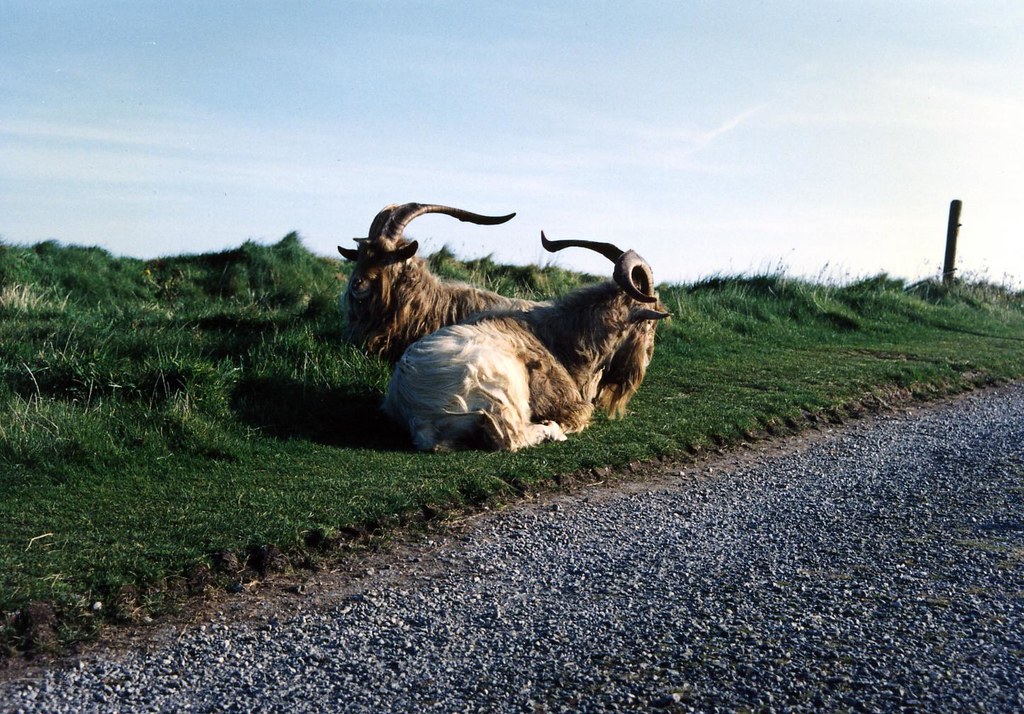
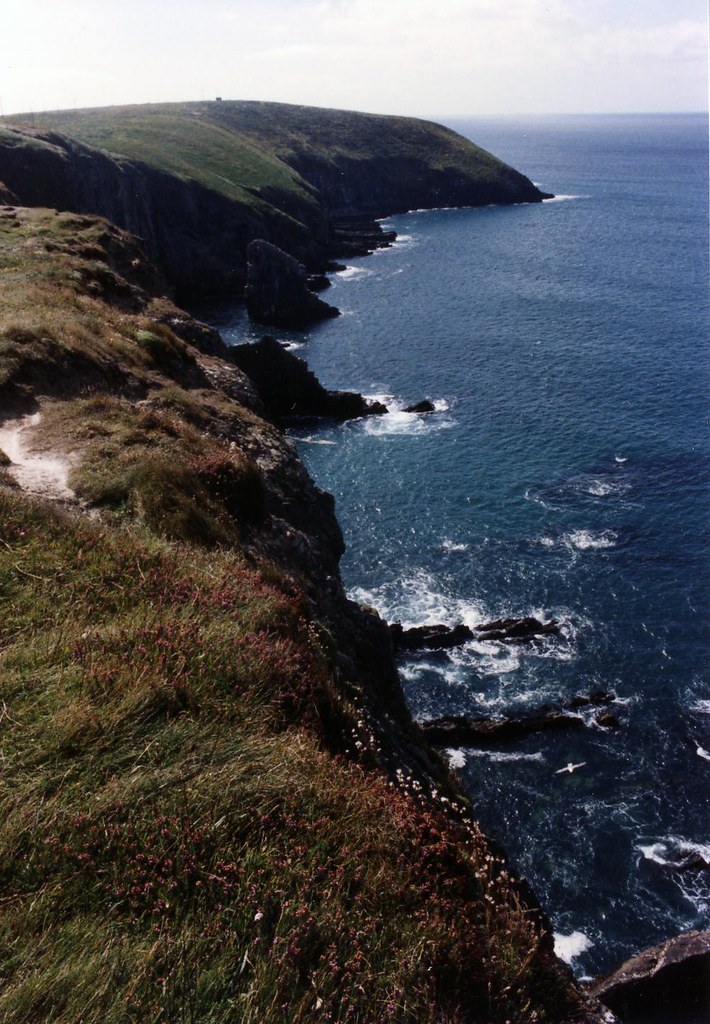
Yesterday I was channel-surfing and ended up watching most of a Discovery HD program on the sinking of the Lusitania, which was torpedoed just a few miles off the Irish coast in 1915--nearest a diamond-shaped strip of land that juts out into the Atlantic, known as the Old Head of Kinsale. As I've mentioned before, my grandparents lived in Kinsale for several years, my grandmother died there, and I've always loved the place--particularly the Old Head, which is one of the most beautiful places in the world. Here's proof:

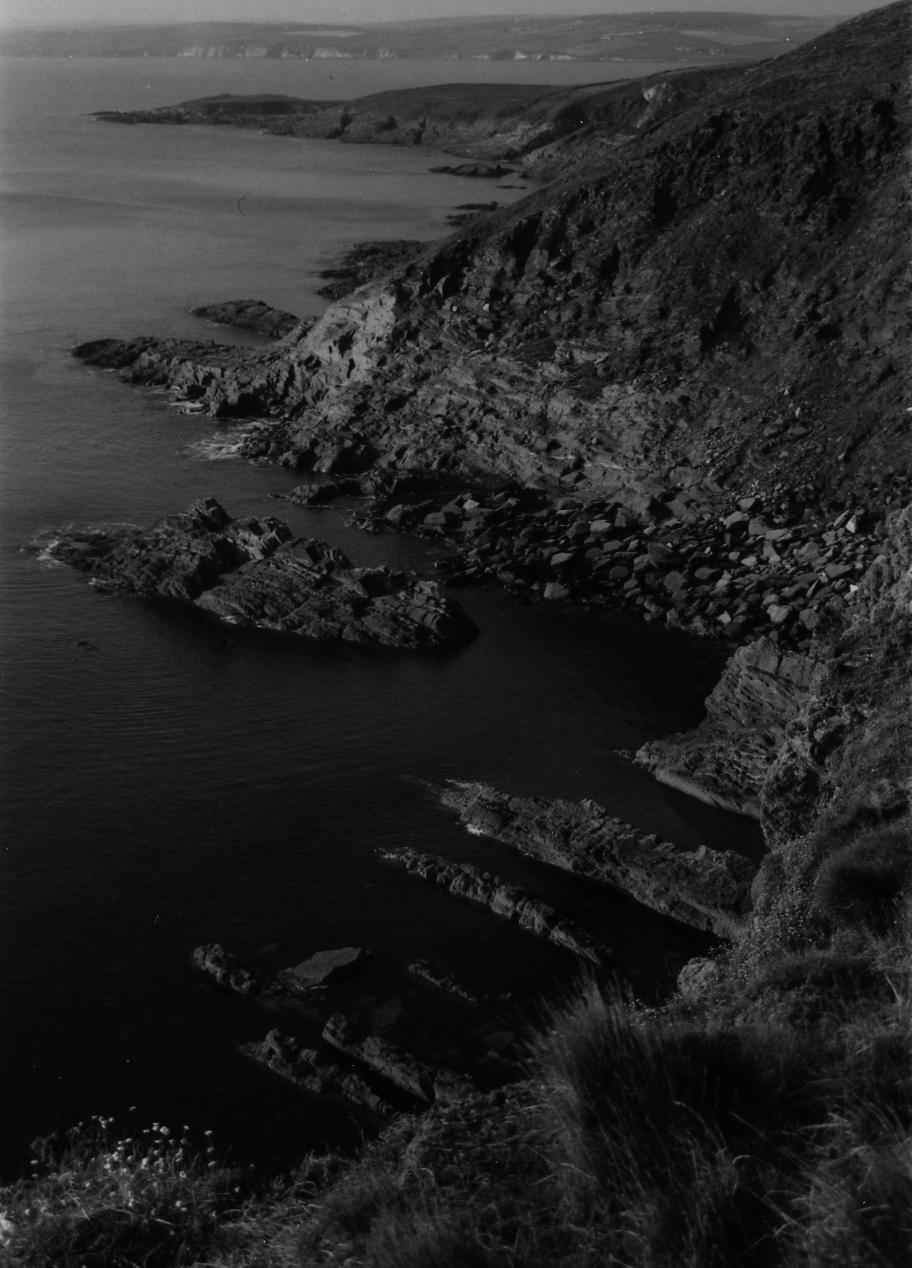
(Mom took that picture, by the way; it's better than any of the ones I took.) The Old Head is one of those geological oddities, a strip of sandstone that will probably be an island someday when the narrow isthmus connecting it to the mainland erodes away, but that someday is very far off indeed. Back when my grandparents lived there, the Old Head simply was. You could go there whenever you liked and explore as much as you wished. And believe me, every time I went to Ireland I made sure to visit the Old Head. To wander for a couple hours, breathe the sea air, revel in the views, find that particular peace that comes with such a beautiful place. And honest, the goats never bothered me even once.
Ah yes, the goats. The stalwart defenders of the Old Head. If they decided they didn't like you, they were perfectly happy chasing you back to your car and then ramming it a few times to let you know that you were not welcome. They were just part of the charm, you see. As you can see from the photo, they were perfectly placid whenever I visited, which can certainly be chalked up to sheer chance, or maybe they just recognized that I too was someone who loved the place as much as they did. If only they had been able to defend the Old Head against the wretched forces of consumerism, then maybe...
The last time I visited, I was given the bad news: some real estate developers had purchased the Old Head, and were planning to put a golf course on it. As an Old Head-loving member of the non-rich general public, I would never be able to go there again. And, indeed, I never have. The course opened ten years ago, and people have been shut out ever since. So when I saw this program on the Lusitania, I was again reminded of the Old Head. And of the enormous crime that has been perpetrated on the people of the world by the owners of that damn golf course.
I went to the course's website (no, I will not link to it, nor honor the place by mentioning its name). Green fees are 295 Euros, which is about $406 in U.S. currency. (For comparison, the legendary old course at St. Andrews, birthplace of golf and one of the homes of the British Open, only costs 125 Euros in the high season, or about $172.) That's not counting rental of a golf cart and a caddy. There's fine dining, for members only. And high fences with razor wire to keep people out.
On their site there is a video where they actually say that the course "helps nature fulfill its potential." As if nature wasn't already doing a spectacular job all on its own, which is why the wretched O'Connor brothers bought the place to begin with. They also advertise helicopter charters "for the discerning golfer," which "cuts out significant time lost on road travel, [and] alleviates time pressures...." Because, don't ya know, their visitors are so in-demand that they simply must be able to chopper in, play a few holes, then get the hell out without having to be bothered by, you know, the rabble on those twisty roads. Why, there's barely a straight road anywhere on the whole island, and you're constantly being stopped because there are sheep being herded across the road!
Of course, some of us see that as one of the great joys of Ireland: the pace is different, and being in a hurry is just plain wrong. Don't these people realize that if the point is to relax by playing a few holes, then stressing out by taking a helicopter in and out completely wrecks the whole thing? Those roads do not efficiently get you from Point A to Point B, no they don't; ain't it great?
But you've gotta love the web. I found this site, Free the Old Head of Kinsale, which is exactly what it sounds like: a site agitating for the Old Head to be opened again to the public. They're not trying to oust the golf course at all, they're not unrealistic about their goals: they simply want a trail, something, to be opened to the public so that the common folk can enjoy this most beautiful of places as they have for centuries. There is apparently a court case pending on this very issue of public right-of-way, and I dearly hope they prevail. In the meantime, there's a web petition you can sign, and I am extremely dismayed to find that my signature was only number 56. Maybe you might find yourself so moved as to visit the site and sign on as well. Here's another reason why you should:
Yesterday I was channel-surfing and ended up watching most of a Discovery HD program on the sinking of the Lusitania, which was torpedoed just a few miles off the Irish coast in 1915--nearest a diamond-shaped strip of land that juts out into the Atlantic, known as the Old Head of Kinsale. As I've mentioned before, my grandparents lived in Kinsale for several years, my grandmother died there, and I've always loved the place--particularly the Old Head, which is one of the most beautiful places in the world. Here's proof:
(Mom took that picture, by the way; it's better than any of the ones I took.) The Old Head is one of those geological oddities, a strip of sandstone that will probably be an island someday when the narrow isthmus connecting it to the mainland erodes away, but that someday is very far off indeed. Back when my grandparents lived there, the Old Head simply was. You could go there whenever you liked and explore as much as you wished. And believe me, every time I went to Ireland I made sure to visit the Old Head. To wander for a couple hours, breathe the sea air, revel in the views, find that particular peace that comes with such a beautiful place. And honest, the goats never bothered me even once.
The last time I visited, I was given the bad news: some real estate developers had purchased the Old Head, and were planning to put a golf course on it. As an Old Head-loving member of the non-rich general public, I would never be able to go there again. And, indeed, I never have. The course opened ten years ago, and people have been shut out ever since. So when I saw this program on the Lusitania, I was again reminded of the Old Head. And of the enormous crime that has been perpetrated on the people of the world by the owners of that damn golf course.
I went to the course's website (no, I will not link to it, nor honor the place by mentioning its name). Green fees are 295 Euros, which is about $406 in U.S. currency. (For comparison, the legendary old course at St. Andrews, birthplace of golf and one of the homes of the British Open, only costs 125 Euros in the high season, or about $172.) That's not counting rental of a golf cart and a caddy. There's fine dining, for members only. And high fences with razor wire to keep people out.
On their site there is a video where they actually say that the course "helps nature fulfill its potential." As if nature wasn't already doing a spectacular job all on its own, which is why the wretched O'Connor brothers bought the place to begin with. They also advertise helicopter charters "for the discerning golfer," which "cuts out significant time lost on road travel, [and] alleviates time pressures...." Because, don't ya know, their visitors are so in-demand that they simply must be able to chopper in, play a few holes, then get the hell out without having to be bothered by, you know, the rabble on those twisty roads. Why, there's barely a straight road anywhere on the whole island, and you're constantly being stopped because there are sheep being herded across the road!
Of course, some of us see that as one of the great joys of Ireland: the pace is different, and being in a hurry is just plain wrong. Don't these people realize that if the point is to relax by playing a few holes, then stressing out by taking a helicopter in and out completely wrecks the whole thing? Those roads do not efficiently get you from Point A to Point B, no they don't; ain't it great?
But you've gotta love the web. I found this site, Free the Old Head of Kinsale, which is exactly what it sounds like: a site agitating for the Old Head to be opened again to the public. They're not trying to oust the golf course at all, they're not unrealistic about their goals: they simply want a trail, something, to be opened to the public so that the common folk can enjoy this most beautiful of places as they have for centuries. There is apparently a court case pending on this very issue of public right-of-way, and I dearly hope they prevail. In the meantime, there's a web petition you can sign, and I am extremely dismayed to find that my signature was only number 56. Maybe you might find yourself so moved as to visit the site and sign on as well. Here's another reason why you should:
Labels:
Entries with pictures,
Ireland,
Kinsale,
Old Head of Kinsale
Sunday, July 22, 2007
Gotta Love Magic Hour
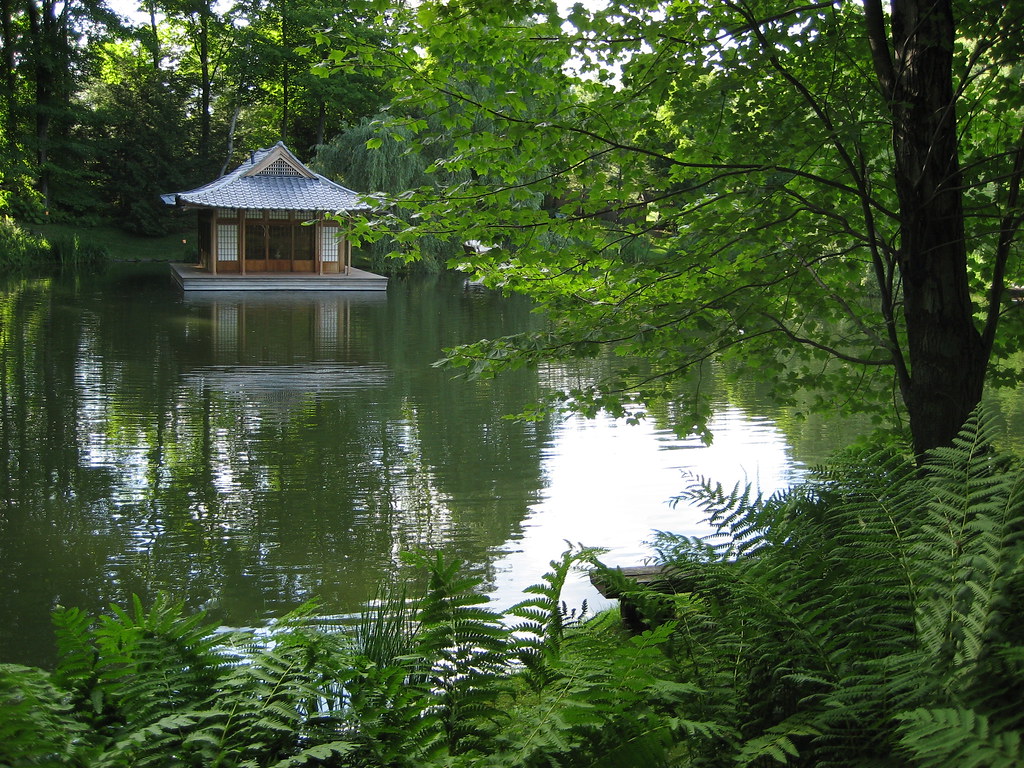
In case anyone was wondering "Why travel all the way to Vermont just to shoot a trailer?" I proffer the following:
I had never been to Vermont before, but quickly decided that it's a lot like Ireland: overwhelmingly green, with contours to die for, one of those places where you could pretty much close your eyes, point a camera at random, and get a good picture. The above was taken when I had no time to do anything but point and click, yet it looks like a postcard. Too damn easy. And if the point is to make something with visual oomph, well, this particular property in gorgeous Vermont does half our work for us.
(And besides--the people in town were unfailingly pleasant, and the food was beyond-belief-good. I was working like crazy and still gained four pounds in four days.)
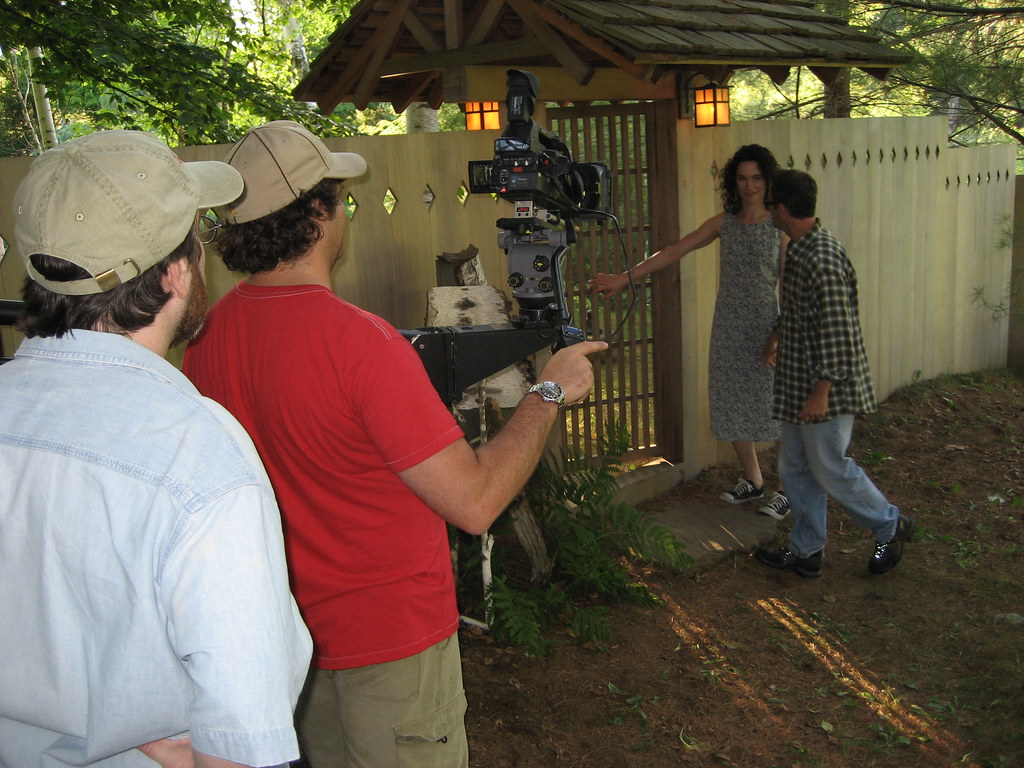
After flying a red-eye, and driving up from Boston (loads of fun to be in Boston again, no matter how briefly), and checking into the hotel, we got off our first shot right at magic hour. A jib-arm shot that floated above a fence to reveal the teahouse, framed in Maxfield Parrish lighting (in fact, Parrish worked in New Hampshire, just next door, so no wonder). Here we've got actors Jennifer Ann Evans and David Goryl doing their thing, while director Marc Rosenbush and DP Chris Gosch do theirs. Me, I had just made the strange Blair Witch-thing, just visible beyond the camera, that was meant to disguise an electrical outlet that would have marred the beauty of the shot. We were supposed to have cloudy weather, with a too-high chance of rain; instead we walked into a painting and shot some film of it. Not bad.
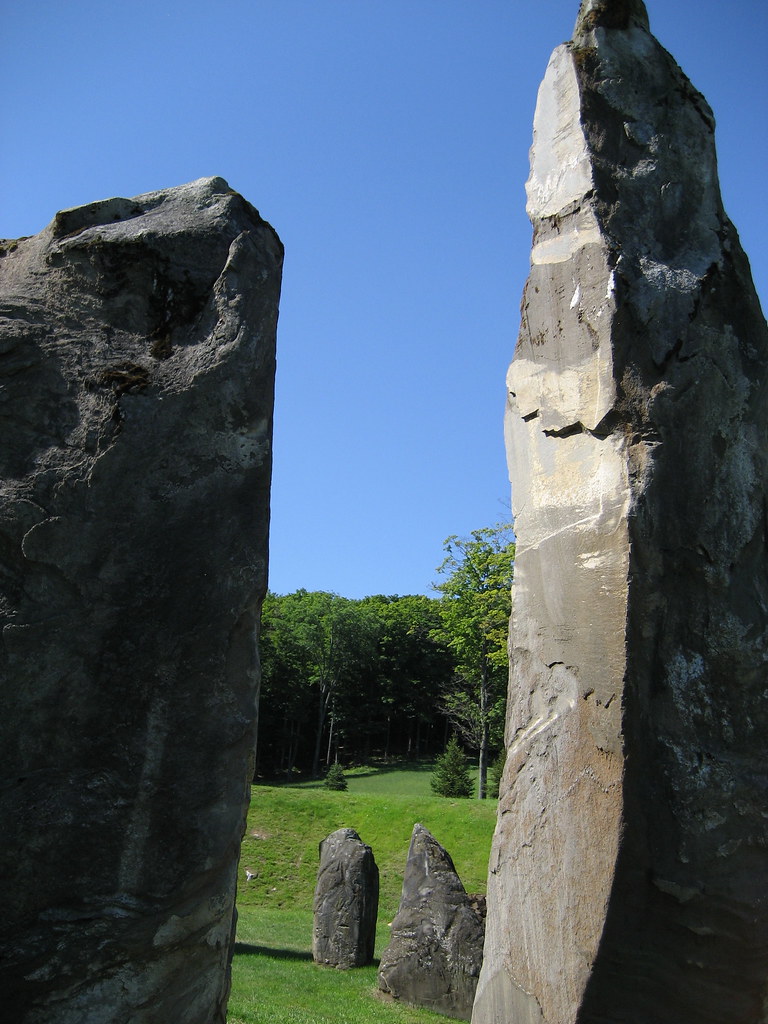
The weather held all through the next day, during which we got the tricky shots: the ones that will require special effects, and compositing and green screens and so forth. There were the beautiful scenes at the teahouse, and at the mini-Stonehenge only a few yards away, and as were working on the last of the tricky effects shots, something blew the power main and we lost power, just as the sun was setting. The next day, it rained. Then rained some more. Then rained harder.
Which is, of course, why everything is so green up there in green green Vermont. We got some interior shots, then started improvising, then kinda had to give up for a while. Went back to the hotel and everyone got a nap for a few hours, till sunset, when the rain finally stopped--and we grabbed a shot at the swimming pond behind the hotel instead of dashing back to the property to get what would have been a nearly identical shot. (Like I said: point a camera practically anywhere in Vermont and you're gonna get something good.)
In the end, we didn't get everything we wanted--but the question remains, did we get everything we needed? Yeah, I think maybe we did. The trailer will be less of a linear storyline and more a progression of interesting images, but that's fine, that's what most trailers are anyway. Now if only we had gotten footage of the time David got attacked by a giant badger...
(And besides--the people in town were unfailingly pleasant, and the food was beyond-belief-good. I was working like crazy and still gained four pounds in four days.)
Which is, of course, why everything is so green up there in green green Vermont. We got some interior shots, then started improvising, then kinda had to give up for a while. Went back to the hotel and everyone got a nap for a few hours, till sunset, when the rain finally stopped--and we grabbed a shot at the swimming pond behind the hotel instead of dashing back to the property to get what would have been a nearly identical shot. (Like I said: point a camera practically anywhere in Vermont and you're gonna get something good.)
In the end, we didn't get everything we wanted--but the question remains, did we get everything we needed? Yeah, I think maybe we did. The trailer will be less of a linear storyline and more a progression of interesting images, but that's fine, that's what most trailers are anyway. Now if only we had gotten footage of the time David got attacked by a giant badger...
Labels:
Entries with pictures,
Trailer shooting,
Vermont
Thursday, April 26, 2007
Where Could They Bee?
Since I was just writing recently about bees, I would be remiss if I did not mention that the bees seem to be going on vacation. Or, to be a little more scientific about it, they're disappearing. By the billions.
As the various articles point out, food crops that rely on honeybees for pollination are worth about $15 billion and include a lot of the fruits and nuts that we all love the most: apples, cherries, almonds, and so forth. There is no adequate mechanical substitute for the pollinating prowess of the honeybee, so if this unknown process should continue, it is reasonable to expect that these staples of our diet will not disappear but will become very expensive from simple scarcity. (Imagine a ten dollar slice of pie.) (Okay, in Los Angeles that's not so far from the truth, but imagine it in Dubuque.)
Bee colonies started to collapse last October: huge numbers of worker bees would simply never return to the hive, up to 50% of the colony in many cases. As CNN reports, most of these bees just plain vanished, and their little bee bodies were never found. Since their failure to return was possibly a failure in their navigation systems, speculation ran rampant on all sorts of causes, including cellphone towers (leading Bill Maher last week to ask, "will we choose to literally blather ourselves to death?"). This New York Times article goes into more detail on the science involved, including this disturbing photo of cross-sections of diseased (left) and healthy (right) bee thoraxes:

A chemical trigger for all this seems most likely, particularly since some hives treated with gamma radiation have begun to recover, suggesting that the gamma is killing some yet-unknown pathogen. But research has barely begun on the problem, and all the while, the bees keep disappearing; and despite some lucky breaks, like the fact that Baylor College of Medicine recently happened to finish sequencing bee DNA (thus speeding up immeasurably a search for genetic triggers), we have no idea how long it will take to find answers to this problem.
Diseased bees are being found to be contaminated with fungi common in humans whose immune systems have been depressed by AIDS or cancer. Thus we learn yet again, we're all connected. The question then becomes, if the bees go, what happens to us?
As the various articles point out, food crops that rely on honeybees for pollination are worth about $15 billion and include a lot of the fruits and nuts that we all love the most: apples, cherries, almonds, and so forth. There is no adequate mechanical substitute for the pollinating prowess of the honeybee, so if this unknown process should continue, it is reasonable to expect that these staples of our diet will not disappear but will become very expensive from simple scarcity. (Imagine a ten dollar slice of pie.) (Okay, in Los Angeles that's not so far from the truth, but imagine it in Dubuque.)
Bee colonies started to collapse last October: huge numbers of worker bees would simply never return to the hive, up to 50% of the colony in many cases. As CNN reports, most of these bees just plain vanished, and their little bee bodies were never found. Since their failure to return was possibly a failure in their navigation systems, speculation ran rampant on all sorts of causes, including cellphone towers (leading Bill Maher last week to ask, "will we choose to literally blather ourselves to death?"). This New York Times article goes into more detail on the science involved, including this disturbing photo of cross-sections of diseased (left) and healthy (right) bee thoraxes:

A chemical trigger for all this seems most likely, particularly since some hives treated with gamma radiation have begun to recover, suggesting that the gamma is killing some yet-unknown pathogen. But research has barely begun on the problem, and all the while, the bees keep disappearing; and despite some lucky breaks, like the fact that Baylor College of Medicine recently happened to finish sequencing bee DNA (thus speeding up immeasurably a search for genetic triggers), we have no idea how long it will take to find answers to this problem.
Diseased bees are being found to be contaminated with fungi common in humans whose immune systems have been depressed by AIDS or cancer. Thus we learn yet again, we're all connected. The question then becomes, if the bees go, what happens to us?
Friday, March 23, 2007
Babies!
Never happened. Monday morning, around 12:30, the smoke detector in her bedroom went off. Wasn't the sort of thing where the battery is going low so it beeps periodically: it all-out went off. No fire anywhere, no smoke anywhere. She and her husband Kent got up, got the device to stop screeching, and went back to bed. Half an hour later it went off again. No one knows why--the device had no history of false alarms. But a couple hours later, she awoke Kent again: the contractions, they weren't stopping. And so off they went.
We've started calling the device a "birth detector."
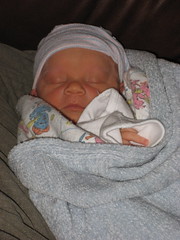
Little Madeleine Anne was born later Monday morning, and on Thursday Marc and I went over to meet the newest member of our little Lightwheel family. An adorable child, as you can see, and remarkably mellow: not a crier at all, I barely heard a peep from her during the hour or so we were there. Monica is tired but resting and recovering; her first child, Alexander, has already declared he's "tired of being a big brother," and Kent was a mixture of pride and weariness. Madeleine, meanwhile, just laid there, being passed from person to person with complete equanimity, her huge baby eyes taking in absolutely everything without any sign of fear or anxiety. A perfect child in a perfect world, while we filled in her mom on all the things that had gone on in the perfect world during the days when she wasn't paying attention.
Tuesday, January 30, 2007
The North Ring Road
Been a while since I blogged, hasn't it? That's largely because I've been busy doing essentially the same stuff: pushing along sales of the Zen Noir DVD and soundtrack. (The DVD is now available on Amazon, and the soundtrack can be downloaded from iTunes, either as a whole album or by the single track. Go on, spend some money, you know you want to!)
So there hasn't been much new to report on from that front, and I haven't really had time to discuss, say, the President's recent State of the Union or anything like that. (Though I will mention how disappointed I was--advance word had been that Bush might actually say something significant about the environment, but in the end he had almost nothing new to say, even with an important new report about to appear--a stark reading of our collective future that already appears to have been watered down.)
But that's all the stuff I don't have time to talk about. Instead, I'm going to tell a little story, about asking directions in Ireland, simply because it's amusing and I like to tell it.
Several years ago, my grandparents were living in Kinsale, County Cork, Republic of Ireland. It's a beautiful little coastal town with the best food in the country (the cooperative they created, called the Good Food Circle, was a stroke of genius), and for several years after their retirement, my grandparents ran a bed & breakfast. By the time of this story, however, they had already retired from their retirement, moved to a smaller house on Worlds End, and I went over by myself to pay a little visit. Spent a few days in Dublin, then rented a car to drive down.
As you can see from the map, Kinsale is just south of the City of Cork; and having made the trip before, I was hoping there might be a way to avoid having to drive through the city center, some sort of country road that might bypass the city altogether. So I stopped in a little town just north of Cork, and ran into a pub in order to use the Gents'.
Long metal trough; sound of rain on a tin roof. As I stood there, one of the bar's patrons, a regular if ever I saw one, came wandering in and stood next to me. Torrential downpour on a tin roof. As I stepped away and washed my hands, he zipped up, looked over and said something that sounded more or less like "Wassonweeyuh?"
I blinked, looked at my watch, and said "A little after three."
"No no," he said. "What's on with ye?"
"Oh!" Been a while since I've heard a good "ye," so I figured the guy was friendly, let's ask him about the roads 'round Cork.
"Ah. What ye do, you see, is you take the Nort' Ring Road to the east do y'see, that'll bring you right round the town."
But as he said this, another of the pub's regulars had come in; gutterspout emptying into a tin can. But he heard what the first guy had said and suddenly interjected: "No, no, no. If he takes the Nort' Ring Road it'll bring him right t'rough the center of town, which is just what he said he was tryin' t'avoid." Zip, step back, advance. "No, what you yis do is you take the Nort' Ring Road to the west, d'ye see, and that'll take yis right round the town."
Back to the first gentle soul: "Are ye mad, Liam? If he takes the Nort' Ring Road to the west it'll take him to fuckin' Kilkenny!"
I left them there, continuing to argue about the best way to go right 'round the town, and set off again in the car. Reached the North Ring Road and headed east. Sure enough, it looked like it was bringing me right into the center of town, so I stopped and doubled back. Retraced my route and, this time, went west on the North Ring Road. The miles passed, I was indeed avoiding the city, the land was all the gentle rolling green of Ireland with no sign of stone cities and traffic. But the signs, they weren't right--by now, shouldn't I be seeing signs for Kinsale? Why instead was I seeing--"Oh crap!" I said, and stopped and turned around, shortly after the first sight of a sign reading "Kilkenny."
I retraced my steps yet again, went east again, went right through the very heart of the City of Cork, dealt with all the traffic, and finally reached my grandparents in Kinsale. Warming up with a nice cuppa, I asked them, "How exactly do you get 'round the city?"
"Oh heavens," said my grandmother. "You can't do that."
So there hasn't been much new to report on from that front, and I haven't really had time to discuss, say, the President's recent State of the Union or anything like that. (Though I will mention how disappointed I was--advance word had been that Bush might actually say something significant about the environment, but in the end he had almost nothing new to say, even with an important new report about to appear--a stark reading of our collective future that already appears to have been watered down.)
But that's all the stuff I don't have time to talk about. Instead, I'm going to tell a little story, about asking directions in Ireland, simply because it's amusing and I like to tell it.
Several years ago, my grandparents were living in Kinsale, County Cork, Republic of Ireland. It's a beautiful little coastal town with the best food in the country (the cooperative they created, called the Good Food Circle, was a stroke of genius), and for several years after their retirement, my grandparents ran a bed & breakfast. By the time of this story, however, they had already retired from their retirement, moved to a smaller house on Worlds End, and I went over by myself to pay a little visit. Spent a few days in Dublin, then rented a car to drive down.
As you can see from the map, Kinsale is just south of the City of Cork; and having made the trip before, I was hoping there might be a way to avoid having to drive through the city center, some sort of country road that might bypass the city altogether. So I stopped in a little town just north of Cork, and ran into a pub in order to use the Gents'.Long metal trough; sound of rain on a tin roof. As I stood there, one of the bar's patrons, a regular if ever I saw one, came wandering in and stood next to me. Torrential downpour on a tin roof. As I stepped away and washed my hands, he zipped up, looked over and said something that sounded more or less like "Wassonweeyuh?"
I blinked, looked at my watch, and said "A little after three."
"No no," he said. "What's on with ye?"
"Oh!" Been a while since I've heard a good "ye," so I figured the guy was friendly, let's ask him about the roads 'round Cork.
"Ah. What ye do, you see, is you take the Nort' Ring Road to the east do y'see, that'll bring you right round the town."
But as he said this, another of the pub's regulars had come in; gutterspout emptying into a tin can. But he heard what the first guy had said and suddenly interjected: "No, no, no. If he takes the Nort' Ring Road it'll bring him right t'rough the center of town, which is just what he said he was tryin' t'avoid." Zip, step back, advance. "No, what you yis do is you take the Nort' Ring Road to the west, d'ye see, and that'll take yis right round the town."
Back to the first gentle soul: "Are ye mad, Liam? If he takes the Nort' Ring Road to the west it'll take him to fuckin' Kilkenny!"
I left them there, continuing to argue about the best way to go right 'round the town, and set off again in the car. Reached the North Ring Road and headed east. Sure enough, it looked like it was bringing me right into the center of town, so I stopped and doubled back. Retraced my route and, this time, went west on the North Ring Road. The miles passed, I was indeed avoiding the city, the land was all the gentle rolling green of Ireland with no sign of stone cities and traffic. But the signs, they weren't right--by now, shouldn't I be seeing signs for Kinsale? Why instead was I seeing--"Oh crap!" I said, and stopped and turned around, shortly after the first sight of a sign reading "Kilkenny."
I retraced my steps yet again, went east again, went right through the very heart of the City of Cork, dealt with all the traffic, and finally reached my grandparents in Kinsale. Warming up with a nice cuppa, I asked them, "How exactly do you get 'round the city?"
"Oh heavens," said my grandmother. "You can't do that."
Monday, December 04, 2006
Interpreting Shakespeare
Recently I've been watching a lot of Shakespeare. The estimable people at Janus Films, who run the Criterion Collection of DVD releases, put out a set of Laurence Olivier's three Shakespeare films (Henry V, Hamlet and Richard III), and I got a copy as a birthday present. (For the record, Olivier also filmed Othello, Merchant of Venice and King Lear, and appeared in an early film of As You Like It, but he didn't direct any of these--and the Othello film was essentially a taping of his stage production.)
It occurs to me that not everyone may remember who Olivier is. I often fall victim to this problem--as one of the great actors of the 20th century, Olivier looms as large in my awareness as, let's say, the Pope does for Catholics. (Plus I'm a bit of an Anglophile, and I've always loved British actors--even today, Vanessa Redgrave, Anthony Hopkins and the impossibly brilliant Ian Holm are among my favorite actors, while the Australians have lately become a force unto themselves.)
Since I have often acted in Shakespeare's plays, and I've read everything at least once, it was by no means the first time I had seen these three films. But it was interesting nonetheless to see them in order like that--and in the Richard III film, there is the particular opportunity to compare Olivier's approach to Shakespeare with that of his great rival, John Gielgud, who plays the Duke of Clarence in that film.
Acting styles come and go like clothing fashions, and if you doubt me, just find a recording of John Barrymore doing soliloquies from Hamlet. In 1936, Gielgud directed a production of Romeo and Juliet in which he had the unusual idea of casting himself as Romeo and Olivier as Mercutio; then after six weeks, they switched roles. The production has become legendary as one of those moments when acting styles seemed to turn on a dime, because Gielgud's Romeo was all beauty and grace, while Olivier stressed the physical and the dynamic. There are no recordings of these performances; but in Richard III, you can watch Gielgud performing (very beautifully) Clarence's long dream speech, and then watch any of Olivier's speeches as Richard, and get a very clear sense of the difference between the two styles.
When I was younger, I appreciated Gielgud but I adored Olivier. Lately, those impressions have switched places. It makes sense: as a young man, Olivier's vigorous, youthful approach was thrilling, while Gielgud's more refined performances didn't have the same immediate, visceral impact. But in Olivier's autobiography, he wrote something that I found particularly interesting (sorry, I don't have the book in front of me so I can't quote it directly): he said that in his approach to the soliloquies, he often picked certain specific lines and really hammered away at them while, in a sense, glossing over the rest of the speech. He cited one of Lear's speeches, writing that in his own head, the speech was essentially "Dad-dah dah-dah dah-dah dah-dah dah-dah / How sharper than a serpent's tooth it is / To have a thankless child!"

It may be the most honest thing he ever wrote about his own work--because with that in mind, suddenly I can see this approach in just about every aspect of these films. They are all collections of great moments, with somewhat loose connections between them. And those great moments are usually designed to showcase Olivier himself to great advantage, and are usually announced by a particular stentorian yell that is essentially identical from production to production. It became the chief weapon in his arsenal of acting tricks, and after hearing it a few times, I have to admit, I began to dread its appearance.

Gielgud, on the other hand, was the most beautiful speaker of verse in the twentieth century, with a velvet voice and a subtlety of approach that I have never seen equaled. He was a member of the great Terry family (Ellen Terry was his great-aunt), and as such represents perhaps the apotheosis of that late-19th century style: forceful but never florid, refined but never precious, and with a complete command of his craft so that every line received its due weight rather than rushing on to the next big moment.
It's interesting that Olivier's reputation is as a very natural, realistic actor of Shakespeare (at least compared to Gielgud), because now I find his work particularly mannered. Maybe that's because Kenneth Branagh's recent performances have been quite a bit more realistic and natural than Olivier's ever were, as I think anyone could see by comparing his 1989 Henry V to Olivier's in 1944. Speaking as a child of the Vietnam generation, as Branagh is as well, I find his anti-war interpretation of the play considerably more interesting than Olivier's rah-rah rouse the troops version, and I love the fact that when he filmed Hamlet he did the whole thing, leaving the script essentially uncut. (Yes, I know, it's a long script, which is why most directors cut it from four and a half hours down to about three; but there have been any number of uncut productions that have demonstrated, over and over again, that the play in its entirety works brilliantly, beginning with Maurice Evans's reportedly-sensational production in 1938.)

But what's particularly interesting, to me at least, is that if you look at Branagh's as the third great interpretive style of Shakespeare performance, it is almost full circle back to Gielgud--or maybe it's more accurate to say that his work represents a successful melding of both Gielgud and Olivier: frequently thrilling like Olivier, but with the yearning and the beauty of a Gielgud performance. Alas, as a director, Branagh suffers in comparison to Olivier, largely because of an unfortunate fondness for too-low comedy (witness Michael Keaton's awful Dogberry in Much Ado About Nothing).
The cycle will spin on, of course. One day, Branagh's performances will seem mannered and unrealistic just as Olivier's are beginning to now; and what I think magical in my forties may seem tired when I have reached my sixties (and am, perhaps, more than a little tired myself). It is all, as Shakespeare said, a part of the very purpose of theatre, "...whose end, both at the first and now, was and is, to hold, as 'twere, the mirror up to nature, to show virtue her own feature, scorn her own image, and the very age and body of the time his form and pressure." And that's why this stuff matters, not just to me: an acting style is as much a reflection of its time as anything else; it hints at who we are at a given moment. Once upon a time, the value of a beautiful Gielgud performance was self-evident; then, during World War II and immediately after, we valued a man of action such as Olivier, even in the refined setting of a Shakespeare play; and now we appreciate a natural, unmannered performance like Branagh's, in this time when mannerism and affectation are so out of favor and "authenticity" is all. (Never mind that much of what we think of as authentic is in fact exactly the opposite--Eminem is not Marshall Mathers, no matter what he says.) What's unfortunate is that Branagh's Shakespeare work, while popular, doesn't matter in the way a Shakespeare performance once mattered--now we want the overheated bang-bang of What's-his-name's Romeo + Juliet, with action and guns substituting for the text. That's a damn shame, but it is, again, a reflection of its time. A movie may seem fixed and immovable, but as one's own perceptions shift with time and age, one realizes that even a movie is malleable, a constantly shifting mirror reflecting not only its own age but ours as well.
It occurs to me that not everyone may remember who Olivier is. I often fall victim to this problem--as one of the great actors of the 20th century, Olivier looms as large in my awareness as, let's say, the Pope does for Catholics. (Plus I'm a bit of an Anglophile, and I've always loved British actors--even today, Vanessa Redgrave, Anthony Hopkins and the impossibly brilliant Ian Holm are among my favorite actors, while the Australians have lately become a force unto themselves.)
Since I have often acted in Shakespeare's plays, and I've read everything at least once, it was by no means the first time I had seen these three films. But it was interesting nonetheless to see them in order like that--and in the Richard III film, there is the particular opportunity to compare Olivier's approach to Shakespeare with that of his great rival, John Gielgud, who plays the Duke of Clarence in that film.
Acting styles come and go like clothing fashions, and if you doubt me, just find a recording of John Barrymore doing soliloquies from Hamlet. In 1936, Gielgud directed a production of Romeo and Juliet in which he had the unusual idea of casting himself as Romeo and Olivier as Mercutio; then after six weeks, they switched roles. The production has become legendary as one of those moments when acting styles seemed to turn on a dime, because Gielgud's Romeo was all beauty and grace, while Olivier stressed the physical and the dynamic. There are no recordings of these performances; but in Richard III, you can watch Gielgud performing (very beautifully) Clarence's long dream speech, and then watch any of Olivier's speeches as Richard, and get a very clear sense of the difference between the two styles.
When I was younger, I appreciated Gielgud but I adored Olivier. Lately, those impressions have switched places. It makes sense: as a young man, Olivier's vigorous, youthful approach was thrilling, while Gielgud's more refined performances didn't have the same immediate, visceral impact. But in Olivier's autobiography, he wrote something that I found particularly interesting (sorry, I don't have the book in front of me so I can't quote it directly): he said that in his approach to the soliloquies, he often picked certain specific lines and really hammered away at them while, in a sense, glossing over the rest of the speech. He cited one of Lear's speeches, writing that in his own head, the speech was essentially "Dad-dah dah-dah dah-dah dah-dah dah-dah / How sharper than a serpent's tooth it is / To have a thankless child!"

It may be the most honest thing he ever wrote about his own work--because with that in mind, suddenly I can see this approach in just about every aspect of these films. They are all collections of great moments, with somewhat loose connections between them. And those great moments are usually designed to showcase Olivier himself to great advantage, and are usually announced by a particular stentorian yell that is essentially identical from production to production. It became the chief weapon in his arsenal of acting tricks, and after hearing it a few times, I have to admit, I began to dread its appearance.

Gielgud, on the other hand, was the most beautiful speaker of verse in the twentieth century, with a velvet voice and a subtlety of approach that I have never seen equaled. He was a member of the great Terry family (Ellen Terry was his great-aunt), and as such represents perhaps the apotheosis of that late-19th century style: forceful but never florid, refined but never precious, and with a complete command of his craft so that every line received its due weight rather than rushing on to the next big moment.
It's interesting that Olivier's reputation is as a very natural, realistic actor of Shakespeare (at least compared to Gielgud), because now I find his work particularly mannered. Maybe that's because Kenneth Branagh's recent performances have been quite a bit more realistic and natural than Olivier's ever were, as I think anyone could see by comparing his 1989 Henry V to Olivier's in 1944. Speaking as a child of the Vietnam generation, as Branagh is as well, I find his anti-war interpretation of the play considerably more interesting than Olivier's rah-rah rouse the troops version, and I love the fact that when he filmed Hamlet he did the whole thing, leaving the script essentially uncut. (Yes, I know, it's a long script, which is why most directors cut it from four and a half hours down to about three; but there have been any number of uncut productions that have demonstrated, over and over again, that the play in its entirety works brilliantly, beginning with Maurice Evans's reportedly-sensational production in 1938.)

But what's particularly interesting, to me at least, is that if you look at Branagh's as the third great interpretive style of Shakespeare performance, it is almost full circle back to Gielgud--or maybe it's more accurate to say that his work represents a successful melding of both Gielgud and Olivier: frequently thrilling like Olivier, but with the yearning and the beauty of a Gielgud performance. Alas, as a director, Branagh suffers in comparison to Olivier, largely because of an unfortunate fondness for too-low comedy (witness Michael Keaton's awful Dogberry in Much Ado About Nothing).
The cycle will spin on, of course. One day, Branagh's performances will seem mannered and unrealistic just as Olivier's are beginning to now; and what I think magical in my forties may seem tired when I have reached my sixties (and am, perhaps, more than a little tired myself). It is all, as Shakespeare said, a part of the very purpose of theatre, "...whose end, both at the first and now, was and is, to hold, as 'twere, the mirror up to nature, to show virtue her own feature, scorn her own image, and the very age and body of the time his form and pressure." And that's why this stuff matters, not just to me: an acting style is as much a reflection of its time as anything else; it hints at who we are at a given moment. Once upon a time, the value of a beautiful Gielgud performance was self-evident; then, during World War II and immediately after, we valued a man of action such as Olivier, even in the refined setting of a Shakespeare play; and now we appreciate a natural, unmannered performance like Branagh's, in this time when mannerism and affectation are so out of favor and "authenticity" is all. (Never mind that much of what we think of as authentic is in fact exactly the opposite--Eminem is not Marshall Mathers, no matter what he says.) What's unfortunate is that Branagh's Shakespeare work, while popular, doesn't matter in the way a Shakespeare performance once mattered--now we want the overheated bang-bang of What's-his-name's Romeo + Juliet, with action and guns substituting for the text. That's a damn shame, but it is, again, a reflection of its time. A movie may seem fixed and immovable, but as one's own perceptions shift with time and age, one realizes that even a movie is malleable, a constantly shifting mirror reflecting not only its own age but ours as well.
Subscribe to:
Posts (Atom)